Release Notes 2026
October 2026
September 2026
August 2026
July Release 2026
June Release 2026
May 2026
April 2026
March 2026
February 2026
Frequently Asked Questions!
How do I access field level help?
How do I see descriptions of codes in enquiry screens?
How do I make a user have read only access
Can I copy and delete lines in data entry screens?
Out of Office
Can I run a report to view security groups against my users?
How do I stop a user posting to prior and future periods?
Delete a payment run
Changing security access to a user
User setup requires multiple screens and is complicated!
De-allocate an AP Payment
How to stop over receipting of orders
Why has my transaction not appeared on the AP Payment run?
Download Templates
Useful information to include when raising Financials cases
Prevent users posting to specific balance classes
Hints and Tips!
General Ledger - Helpful how-to guides
General Ledger Data Entry
Journal Upload
Journal Entry, Copy and Authorise
Multi Level Authorisation
Modernisation Budget Upload
General Ledger Enquiries
GL Enquiries - Transaction Enquiries
GL Enquiries - Balance Sheet & Profit and Loss
GL Enquiries - Account Details
Trial Balance
Period and Year End Close
General Ledger Security
Accounts Payable - Helpful how-to guides
Accounts Payable Supplier File
Accounts Payable Data Entry
Log and Invoice/Credit note
Enter a logged Invoice
Enter a non order related Invoice
Order Related Invoice
Order Related Invoices with Mismatches
Order Related Invoice - Mismatch Scenarios
Mismatch Types
Invoice and Credit Note Matching
Accounts Payable Enquiries
Accounts Payable Transaction Maintenance
Accounts Payable Payment Processing
Accounts Payable Code Tables
Accounts Payable Reports
Accounts Receivable - Helpful how-to guides
Customer Maintenance
Enquiries
Cash Allocation
Data Entry & Contracts
Student Sponsor - Education sector
Credit Control
Credit Control Overview
Customer Statements
Diary Notes
Query Management
Interest Charges
Dunning Process
Credit Control Diary
Reporting within Financials
Student Sponsor - Education Sector
Purchasing Management - Helpful how-to guides
Fixed Assets - Helpful how-to guides
Prompt File - Asset Creation
Join Prompt File Items
Fixed Assets Period End & Depreciation
Revaluation
Disposals
Relife
Reconciliation process - Helpful how-to guides
Daily Checks
Accounts Receivable Reconciliation Reporting
Accounts Payable Reconciliation Reporting
Fixed Assets Reconciliation Reporting
General Ledger Reconciliation Reporting
Purchasing Management Reconciliation Reporting
Reporting
General Ledger Reports
Accounts Payable Reports
Accounts Receivable Reports
Sales Invoicing Reports
Fixed Assets Reports
Bank Reconciliation Reports
Import Tool Kit
Procurement Portal
Procurement Portal new User Interface
Navigation
Requisitions
Orders
Authorisation
Receiver
Invoice Clearance
Portal Administration
Procurement Portal - Teams Setup
Invoice Manager
Purchase Invoice Automation (PIA)
February Release notes
March Release Update
January 2026 Release notes
Deleting Supplier training data
Password Reset in Smart-Capture
Adding a New User - Smart Workflow
Resetting password - Smart Workflow
Purchase Invoice Automation
Reprocessing Failed OCR Supplier Invoices
How to Create a New User in Smart-Capture
Smart Capture Email Configuration Overview
Configuring Smart Capture to use Gmail in the Web UI
Configuring Smart Capture to use Microsoft 365 (Graph API) in the Web UI
MAP Configuration Non-Microsoft and Non-Google Accounts
New User Interface
Flow Headstart Forms
Request a nominal
Request a customer
Request a Sales Invoice
Request a management code
Create a Pay Request
Request a Supplier
Bring Your Own BI (BYOBI)
Collaborative Planning
Financial Reporting Consolidation
Air Approvals
Registering Air Approvals
Air Approvals Administration – Create Mobile User
Air Approvals Administration – Reset User’s Activation Key
Reviewing Approvals
Disable/Enable a User
Delete a User
API
Release Notes 2025
December 2025
November 2025
October 2025
September 2025
August 2025
July 2025
June 2025
May 2025
April 2025
March 2025
February 2025
January 2025
Release Notes 2024
December 2024
November 2024
October 2024
September 2024
August 2024
July 2024
June 2024 Release
May 2024
April 2024
March 2024
February 2024
January 2024
Release Notes - Previous years
Contents
- All categories
- Release Notes 2026
- October 2026
October 2026
 Updated
by Caroline Buckland
Updated
by Caroline Buckland
Financials October Release
Release Notes
This document contains details of new and amended functionality included in the software update deployed on 12th October. We've rolled out the following enhancements this month.
· Accounts Receivable User Data
· Validation on Duplicate Location codes
· Non mandatory VAT codes on Customers
· Portals – new setting to define GL account when using Item codes
· GL Journal screen change
· AFX Updates
External References for Accounts Receivable Transactions
Details of the change
We have now delivered the final part of the extended data fields for Accounts Receivable Transactions. Follow the link the below to learn how to set this new feature up.
Details
Enhanced User Data for Sales Invoices
We've introduced a new capability that allows user data created for Sales Invoices to be seamlessly extended to Accounts Receivable (AR). As a result, the data will now be automatically passed through from the Sales Invoice to AR.
We recommend configuring SI Extended User Data and AR Extended User Data in the same manner for both transactions and items. This unified approach ensures that data is accurately and efficiently transferred between the two systems.
Current Limitations
Please note that these extended user data fields are not currently accessible via APIs or Jasper reports.
April 2026 - Help | Financials
Duplicate locations – Purchasing
Details of the change
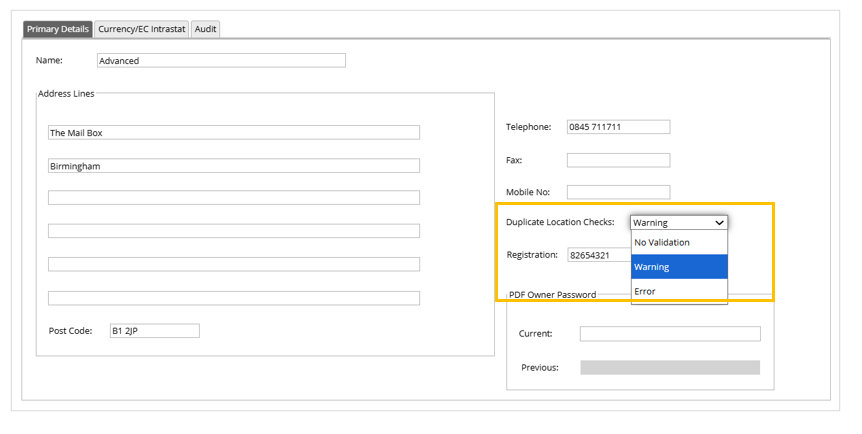
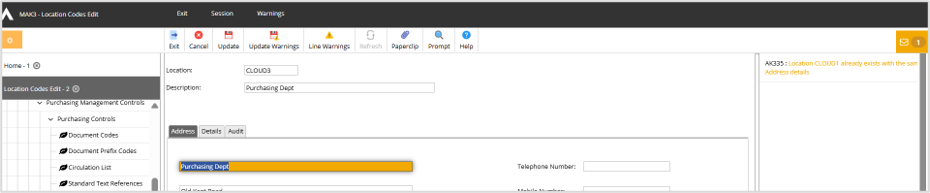
We've introduced a new feature that enables postcode and address line one validation for location codes. This enhancement allows you to configure a setting that displays a warning or error message when a user tries to create a new location with a postcode and address line one that already exists. This improvement helps maintain data integrity and prevents duplicate location codes being created.
To make the most of this feature, you can adjust the setting according to your needs, choosing between a warning or an error message, depending on your organisation's requirements.
Setup
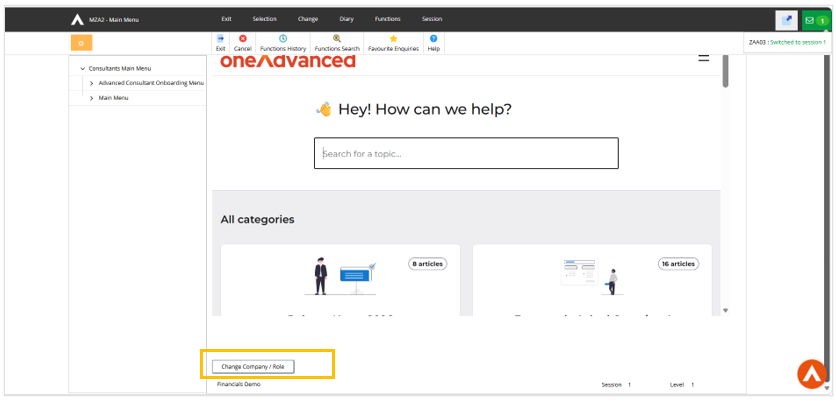
Select Change Company/Role button
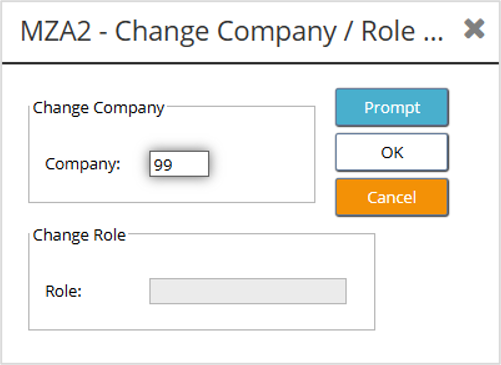
Enter your company code in the window and then select F4 on the keyboard.
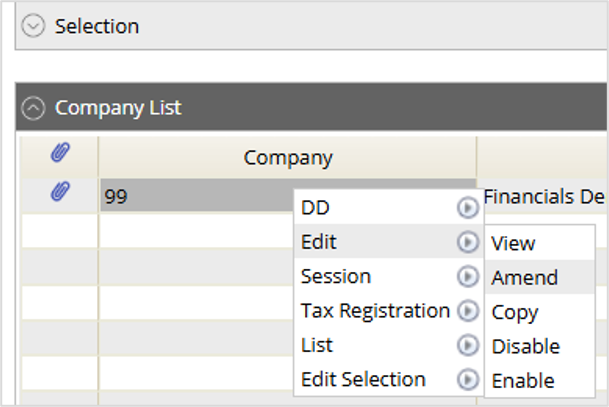
Select the Edit>Amend action.
Select from the drop-down menu to this set as a warning, or error for any duplicates entered.
When setting up new Location codes with the same Postcode and address line one, the following message are displayed.
Non mandatory VAT codes on Customers
Details of the change
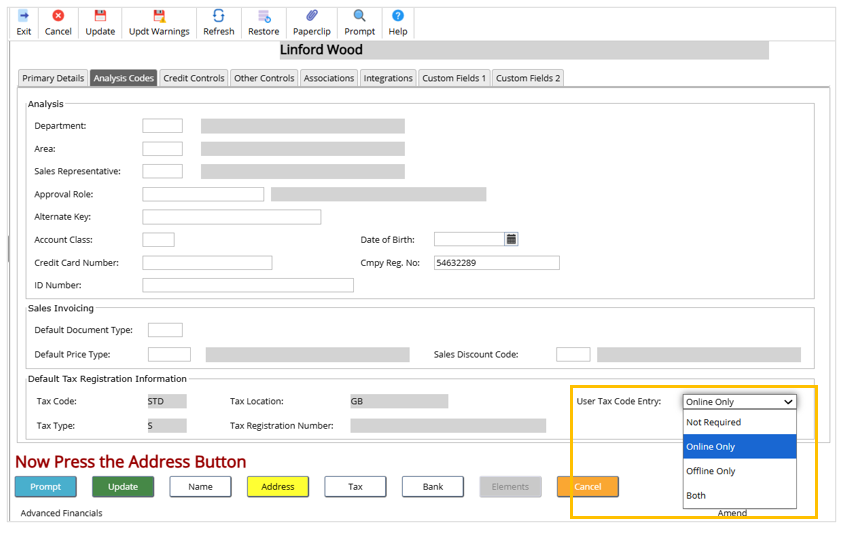
We've introduced an update to our Accounts Receivable feature, providing greater control over VAT code entry during data entry. This new functionality allows you to configure a setting against a specific customer, ensuring that users are prompted to manually enter a VAT code rather than the default code associated with that customer.
This change was applied to Suppliers in the September Release.
For more details select the link September 2026 - Help | Financials
Exclusions
Any system generated transactions that require a tax code (e.g. AR generated interest charges) will continue to use a default tax code as the user has no interaction with these transactions.
Additional changes will be required to the API’s and reporting for the new customer and supplier control changes for the new indicator to control data entry defaulting of tax codes.
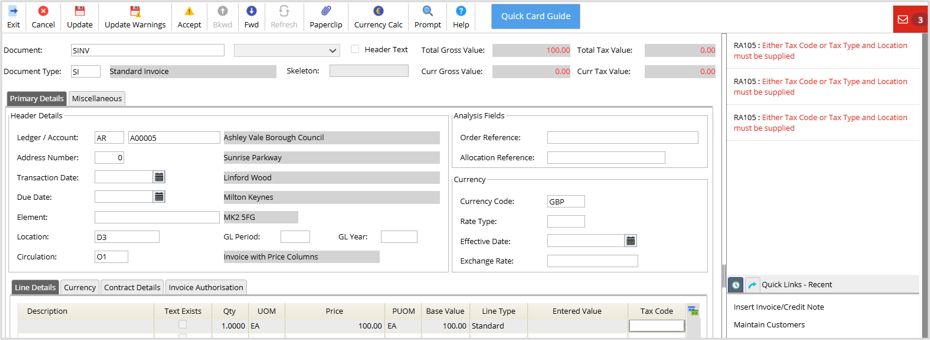
Tax code entry is then a mandatory entry when creating documents.
Portals – new setting to define GL account when using Item a default item
Details of the change
The GL account can be cleared and then automatically re-defaulted on the Requisition and Order Basket screens when the Item code is updated. This functionality can be controlled through configurable system settings on the Administration tool.
Here's how it works:
When the Setting is Off
- The GL account will not be cleared when the Item code is changed.
When the Setting is On
- Entering an Item Code: If you enter an Item code for the first time, the GL account will be cleared.
- Removing an Item Code: If you remove an Item code that was previously entered, the GL account will not be cleared.
- Changing the Item Code: If you change the Item code, the GL account will be cleared.
- Not Changing the Item Code: If you don't change the Item code, the GL account will not be cleared.
This behaviour applies to both the Orders and Requisitions screens.
Setup
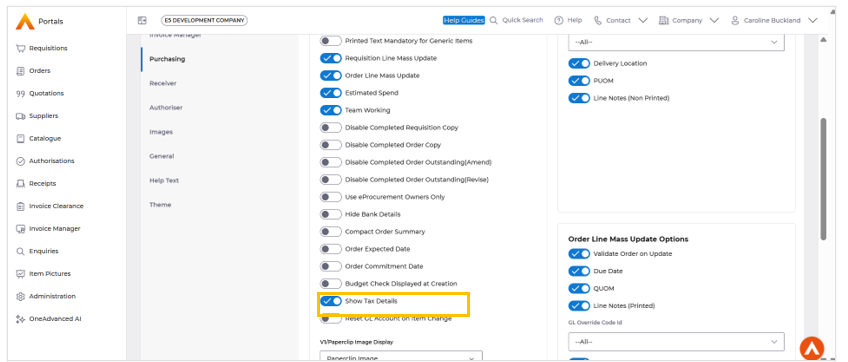
A new toggle control has been added:
Administration → Purchasing → Reset GL Account on Item Change
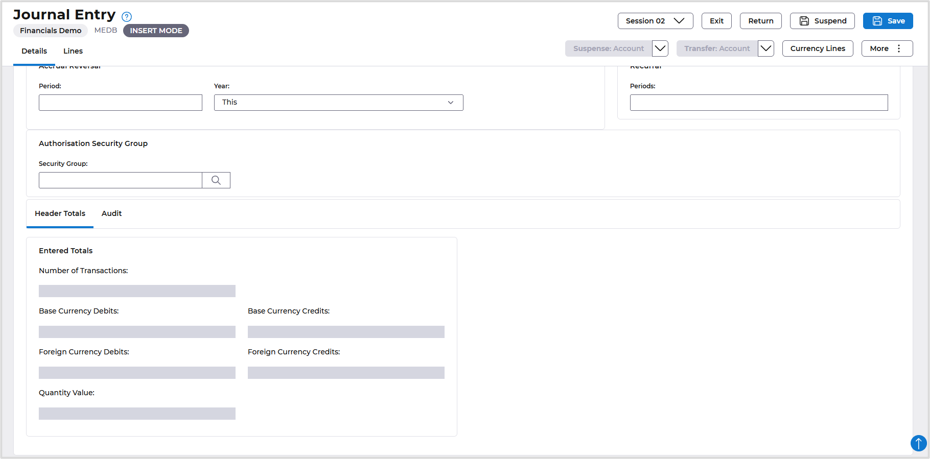
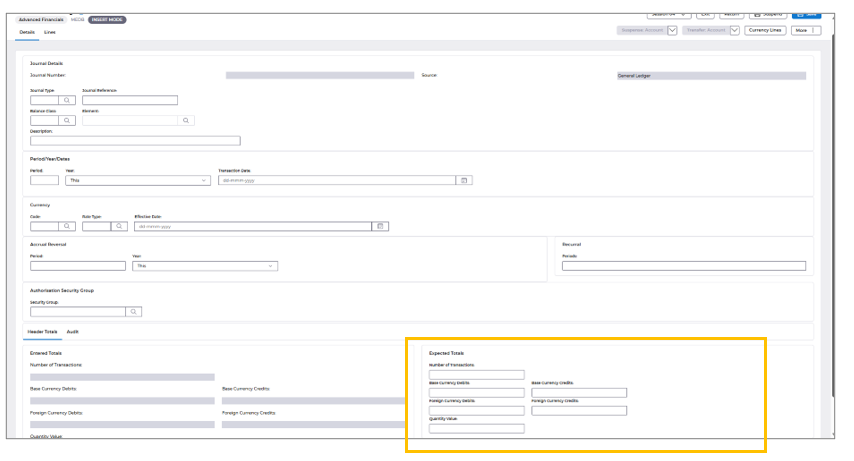
Journal Data Entry
Current Version
New Version – expected total fields added
AFX Updates
- Improved accessibility in the Supplier List – Drawer treeview by ensuring the aria-labelled by attribute references a valid, unique ID that exists in the DOM and provides the intended accessible name (EFIVE-39554).
- Enhanced the Supplier List – Drawer treeview structure by ensuring that only valid tree child roles, such as treeitem and group, are used within the tree hierarchy (EFIVE-39555).
- Improved accessibility of the Supplier List – Drawer menu search by updating the label or ARIA attribute to reference a valid, unique ID in the DOM and correctly associate the label with the search control (EFIVE-39557).
- Fixed an issue where the Due Date was not populating on the Invoice Header after validation in AFX, ensuring the expected due-date information is displayed correctly (EFIVE-40631).
- Fixed an issue with the Calculator function incorrectly rounding off values in lines, ensuring calculated values retain the expected precision (EFIVE-40756).
