Release Notes 2026
September 2026
August 2026
July Release 2026
June Release 2026
May 2026
April 2026
March 2026
February 2026
Frequently Asked Questions!
How do I access field level help?
How do I see descriptions of codes in enquiry screens?
How do I make a user have read only access
Can I copy and delete lines in data entry screens?
Out of Office
Can I run a report to view security groups against my users?
How do I stop a user posting to prior and future periods?
Delete a payment run
Changing security access to a user
User setup requires multiple screens and is complicated!
De-allocate an AP Payment
How to stop over receipting of orders
Why has my transaction not appeared on the AP Payment run?
Download Templates
Useful information to include when raising Financials cases
Prevent users posting to specific balance classes
Hints and Tips!
General Ledger - Helpful how-to guides
General Ledger Data Entry
Journal Upload
Journal Entry, Copy and Authorise
Multi Level Authorisation
Modernisation Budget Upload
General Ledger Enquiries
GL Enquiries - Transaction Enquiries
GL Enquiries - Balance Sheet & Profit and Loss
GL Enquiries - Account Details
Trial Balance
Period and Year End Close
General Ledger Security
Accounts Payable - Helpful how-to guides
Accounts Payable Supplier File
Accounts Payable Data Entry
Log and Invoice/Credit note
Enter a logged Invoice
Enter a non order related Invoice
Order Related Invoice
Order Related Invoices with Mismatches
Order Related Invoice - Mismatch Scenarios
Mismatch Types
Invoice and Credit Note Matching
Accounts Payable Enquiries
Accounts Payable Transaction Maintenance
Accounts Payable Payment Processing
Accounts Payable Code Tables
Accounts Payable Reports
Accounts Receivable - Helpful how-to guides
Customer Maintenance
Enquiries
Cash Allocation
Data Entry & Contracts
Student Sponsor - Education sector
Credit Control
Credit Control Overview
Customer Statements
Diary Notes
Query Management
Interest Charges
Dunning Process
Credit Control Diary
Reporting within Financials
Student Sponsor - Education Sector
Purchasing Management - Helpful how-to guides
Fixed Assets - Helpful how-to guides
Prompt File - Asset Creation
Join Prompt File Items
Fixed Assets Period End & Depreciation
Revaluation
Disposals
Relife
Reconciliation process - Helpful how-to guides
Daily Checks
Accounts Receivable Reconciliation Reporting
Accounts Payable Reconciliation Reporting
Fixed Assets Reconciliation Reporting
General Ledger Reconciliation Reporting
Purchasing Management Reconciliation Reporting
Reporting
General Ledger Reports
Accounts Payable Reports
Accounts Receivable Reports
Sales Invoicing Reports
Fixed Assets Reports
Bank Reconciliation Reports
Import Tool Kit
Procurement Portal
Procurement Portal new User Interface
Navigation
Requisitions
Orders
Authorisation
Receiver
Invoice Clearance
Portal Administration
Procurement Portal - Teams Setup
Invoice Manager
Purchase Invoice Automation (PIA)
February Release notes
March Release Update
January 2026 Release notes
Deleting Supplier training data
Password Reset in Smart-Capture
Adding a New User - Smart Workflow
Resetting password - Smart Workflow
Purchase Invoice Automation
Reprocessing Failed OCR Supplier Invoices
How to Create a New User in Smart-Capture
Smart Capture Email Configuration Overview
Configuring Smart Capture to use Gmail in the Web UI
Configuring Smart Capture to use Microsoft 365 (Graph API) in the Web UI
MAP Configuration Non-Microsoft and Non-Google Accounts
New User Interface
Flow Headstart Forms
Request a nominal
Request a customer
Request a Sales Invoice
Request a management code
Create a Pay Request
Request a Supplier
Bring Your Own BI (BYOBI)
Collaborative Planning
Financial Reporting Consolidation
Air Approvals
Registering Air Approvals
Air Approvals Administration – Create Mobile User
Air Approvals Administration – Reset User’s Activation Key
Reviewing Approvals
Disable/Enable a User
Delete a User
API
Release Notes 2025
December 2025
November 2025
October 2025
September 2025
August 2025
July 2025
June 2025
May 2025
April 2025
March 2025
February 2025
January 2025
Release Notes 2024
December 2024
November 2024
October 2024
September 2024
August 2024
July 2024
June 2024 Release
May 2024
April 2024
March 2024
February 2024
January 2024
Release Notes - Previous years
Contents
- All categories
- Release Notes - Previous years
- September 2022
September 2022
 Updated
by Caroline Buckland
Updated
by Caroline Buckland
Credit limits
The Accounts Receivable module now allows a credit limit to be maintained for each individual customer. This credit limit is used during Invoice entry (MODB) and checks whether it will exceed the allowed credit the customer has been allocated. Automatic updates can be performed to apply stop credit codes to the customer’s account when credit limits have been exceeded.
If a customer is part of a group/subsidiary association, a group credit limit can also be specified that represents the overall credit limit that is available to all customers in that association.
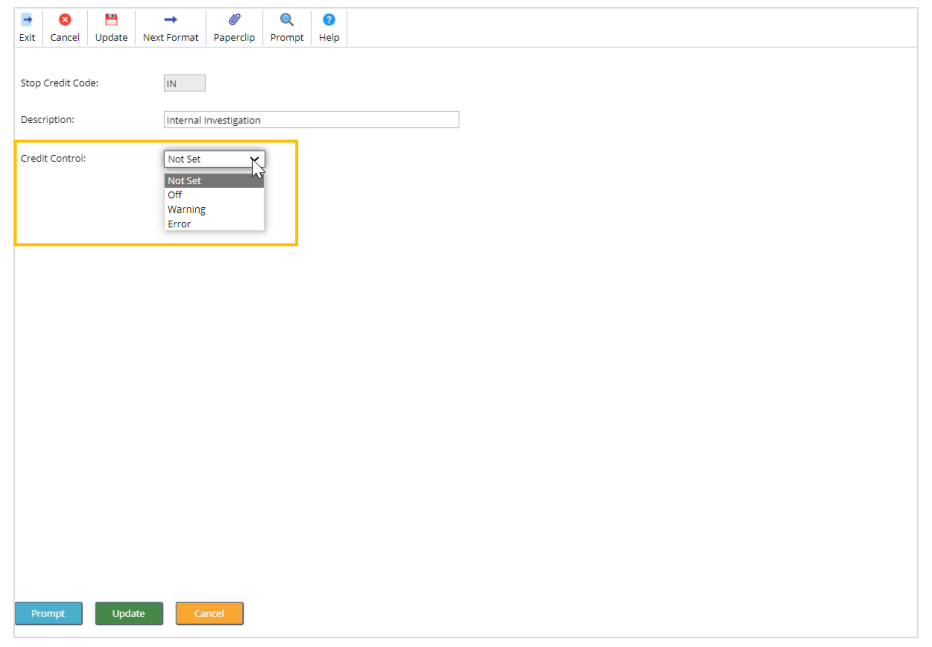
Setup - Stop Credit codes (MBZA)
There is a new credit control setting indicator available to set, if the stop credit code is entered on the customer account this setting will determine what message is displayed during data entry when the credit limit has been exceeded. If set to warning then you can proceed to update the document after accepting the warnings, if you set this to error, you will be unable to update the document.
Access the following menu options: System Admin>Module Controls>Accounts Receivable Controls>AR Credit Management Controls>Stop Credit Codes
Setup - Customer Controls (MBCD)
The customer controls format has the following new controls available:
Access the following menu options: Accounts Receivable>AR Processes>Customers>Maintain Customers>Controls Format>Credit Controls tab.
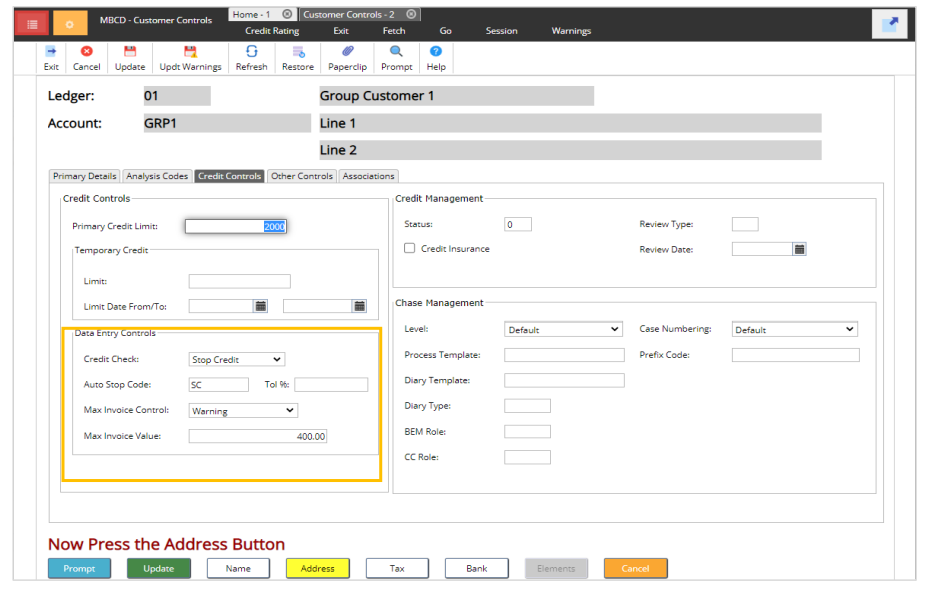
The Credit Check option will override Sales Invoicing company controls to determine whether the credit control checks in Sales Invoicing are performed.
Default – will look at the settings on the Sales Invoicing Company Controls.
Off – the credit checks are not used for this customer.
Warning - this will allow you to enter a Sales Invoice, but you will have to accept the warning if the credit limit is exceeded.
Error - you will be unable to enter a Sales Invoice if the credit limit is exceeded.
Selecting the Stop Credit option will automatically set the Auto Stop Code for the customer when their credit limit has been exceeded. Setting this against the customer you can continue to allow the transaction to be raised and when the credit limit has been exceeded it will generate a warning that the customer will be placed on Stop Credit with an assigned Stop Credit Code. If a Tolerance Percentage has been entered, then this will only apply if the credit limit has been exceeded by this additional percentage. The stop credit code can be entered on the Primary details tab.
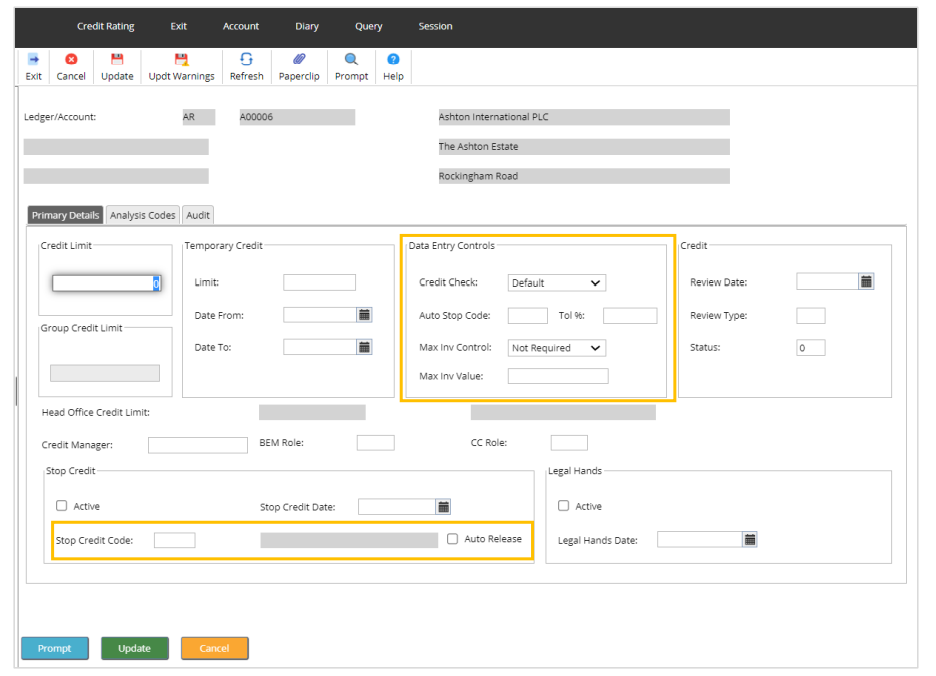
Auto Stop Code - It will only be populated when the Credit Check Indicator is set to Stop Credit and is used to automatically populate the existing stop credit code on the customer when the credit limit has been exceeded.
Tolerance % - It can only be populated when the Credit Check Indicator is set to Stop Credit and is used to calculate the tolerance percentage that the credit limit must be exceeded before the automatic rules for stopping credit apply.
Max Invoice Control – when entering an invoice if the value (including any tax) exceeds a defined amount (in base currency) either a warning or error will be issued.
- Not Required
- Warning
- Error
Max Invoice Value – maximum value when entering an invoice. If the invoice value (including any tax) exceeds a defined amount (in base currency) either a warning or error will be issued (depending upon the new Indicator).
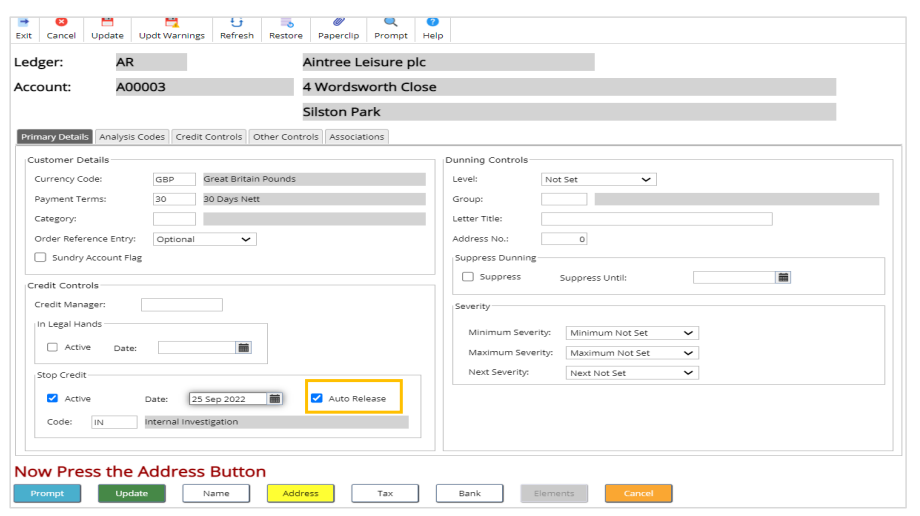
There is also a new flag added on the Primary Details tab.
Auto Release Customer Stop Credit Flag - allows for the automatic removal of the stop credit controls code when the customer’s credit limit has no longer been exceeded.
During data entry, this setting is used to determine if the stop credit controls are removed automatically when the balance of the customer is reduced by a payment that will cause the overall customer balance to now be lower that the agreed credit limit.
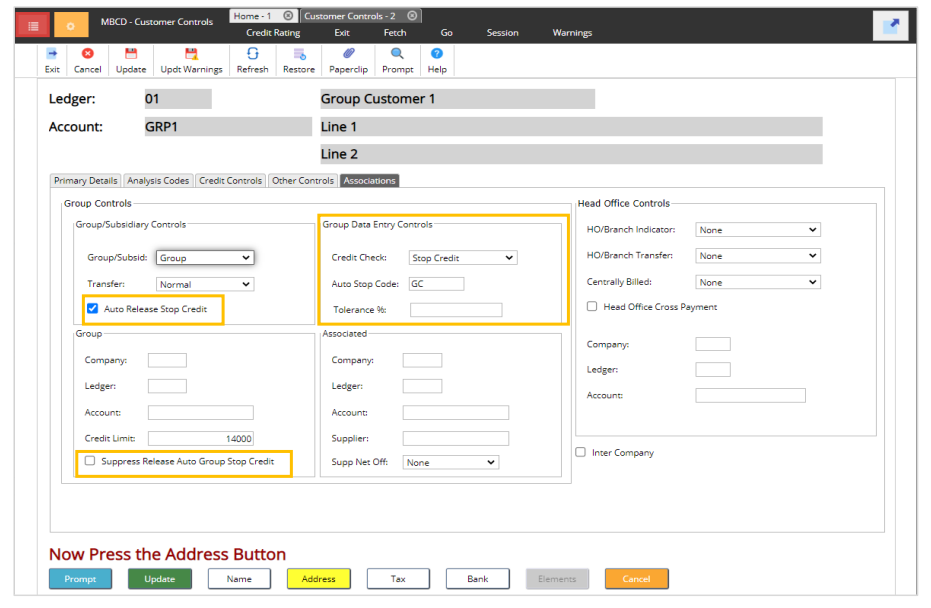
New customer controls format - associations tab
The Group Associations has the Check Credit controls, Auto Stop Code and Tolerance options available along with the addition of the following two flags.
Auto Release Group Stop Credit - this allows the automatic removal of the stop credit controls when the group’s credit limit has no longer been exceeded, for example when a payment has been made.
Suppress Auto Release - can be used when the group customer has the Auto Release Group Stop Credit Flag set to release all customers in the association, but the organisation requires that certain customers in the association are not automatically released.
Setup Credit limit (MBFR)
The controls that are created on the Customer Controls screen can also be updated from this screen.
Access the following menu options: Accounts Receivable>AR Processes>Credit Controls>Credit Control List> Access the Primary Details tab to locate the Data Entry Controls.
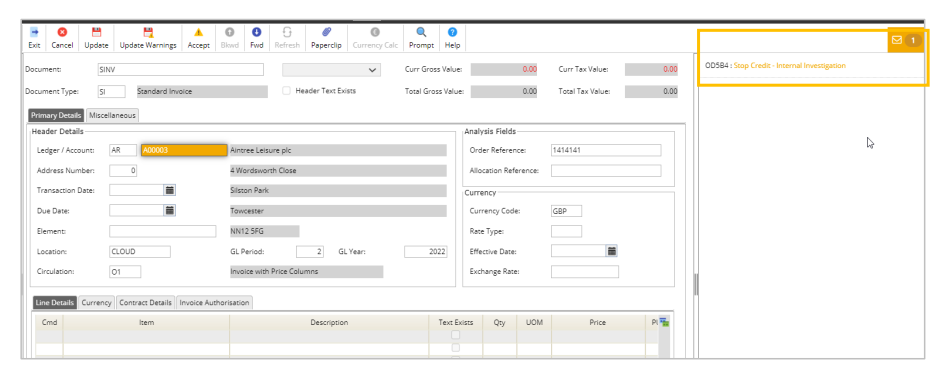
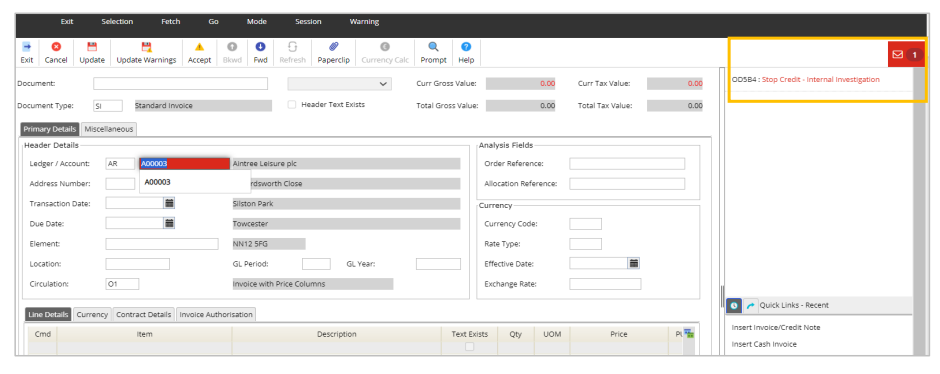
Data entry - Insert Invoice/Credit Note (MODB)
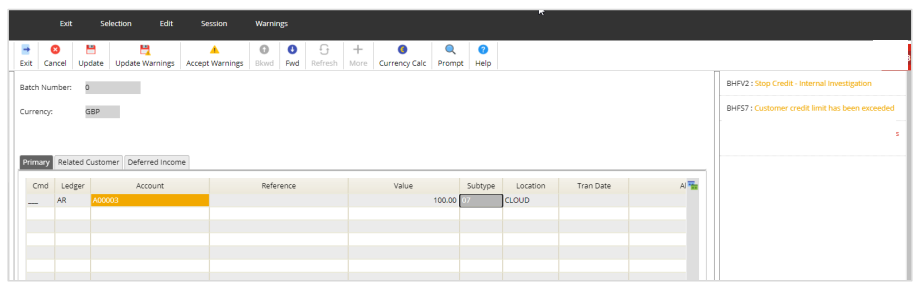
Example of the warning and error message retrieved when inserting a new Sales Invoice.
Access the following menu options: Accounts Receivable>AR Processes>AR Data Entry>Insert Invoice/Credit Note
Data entry - Cash adjustment entry (MBHB)
Example of the warning message retrieved when entering a cash adjustment, only warning messages will be displayed on this screen.
Access the following menu options: Accounts Receivable>AR Processes>AR Data Entry>Cash/Adjustment Entry